
By Conrad Mwanawashe & Kirsty Chibovero
Decades of breeding culminate in a high-yielding, rust-tolerant, high-protein white flour variety designed for the miller, baker and consumer as much as the farmer.
RATTRAY ARNOLD RESEARCH STATION, Shamva – In agriculture, the innovations that change a sector rarely arrive overnight. Behind every new variety that reaches a farmer’s field lies a long, largely invisible cycle of crossing, selection, multi-location testing, agronomic evaluation and seed multiplication.
That patient investment was on full display at Seed Co‘s inaugural Wheat Field Day, held under the theme “SCW9104: Growing Zimbabwe’s Wheat Future – Driving Economic Growth and Food Security”, where the company showcased its new flagship wheat variety, SCW9104.
The variety is the latest product of a wheat breeding programme that Seed Co has run continuously since 1981. Over more than four decades, the programme has delivered successive generations of varieties that helped underpin Zimbabwe’s wheat self-sufficiency, including the more recent SC Nduna, SC Select and SC Serena.
Seed Co Zimbabwe Managing Director Felistas Ndawi-Gurajena said SCW9104 “represents the continuation of decades of breeding, testing and learning, translated into a product designed around the changing needs of Zimbabwean agriculture.” She explained that the new white flour variety was developed in response to new disease strains, climate variability and, importantly, evolving customer preferences.
Innovation as the engine of the wheat story
The launch comes at a high point for Zimbabwe’s wheat sector. The 2025 season produced a record harvest of more than 640,000 tonnes, well above the national requirement of about 360,000 tonnes. For the 2026 winter season, Government targeted about 125,000 hectares and around 660,000 tonnes, and by June approximately 128,000 hectares had already been planted.
But Ndawi-Gurajena argued that the next chapter must be measured by more than tonnage. “It must be about the economics behind every tonne: productivity per hectare, quality, efficiency, resilience, market acceptance and ultimately the farmer’s return on investment,” she said. This, she added, is what Seed Co calls the “farmer profit story”, in which superior genetics work together with good agronomy, sound farm management and effective extension support.
What sets SCW9104 apart
SCW9104 is a high-yielding, medium-late maturing wheat variety with a yield potential of around 10.5 tonnes per hectare. For growers, a higher yield ceiling spreads fixed costs such as land preparation, irrigation, electricity and mechanisation across more tonnes, directly strengthening margins.
Yield, however, is protected only as well as the crop is protected. SCW9104 carries strong tolerance to rust diseases, including yellow or stripe rust, as well as good tolerance to emerging disease strains. Rust can rapidly destroy leaf area and cut grain fill, and genetic tolerance reduces both yield risk and the cost of repeated fungicide programmes.
Where SCW9104 truly distinguishes itself is end-use quality. It combines good milling and baking qualities with protein content above 13 percent, supporting the gluten strength bakers need for loaf volume and texture, and the white flour colour increasingly demanded across the value chain. For millers, that means grain that performs consistently; for bakers, predictable flour; for consumers, the product attributes they value.
“What makes this exciting is not yield alone,” Ndawi-Gurajena said. “The future farmer needs a variety that can combine productivity with resilience and quality. The miller needs grain that performs. The baker needs consistent flour performance. The consumer needs the product attributes they value. SCW9104 is our response to this entire value chain.”
She described the thinking behind the variety as farmer-centric innovation: “starting with the farmer’s reality, understanding the market, applying science and bringing the solution back to the field.”
From flour to the table
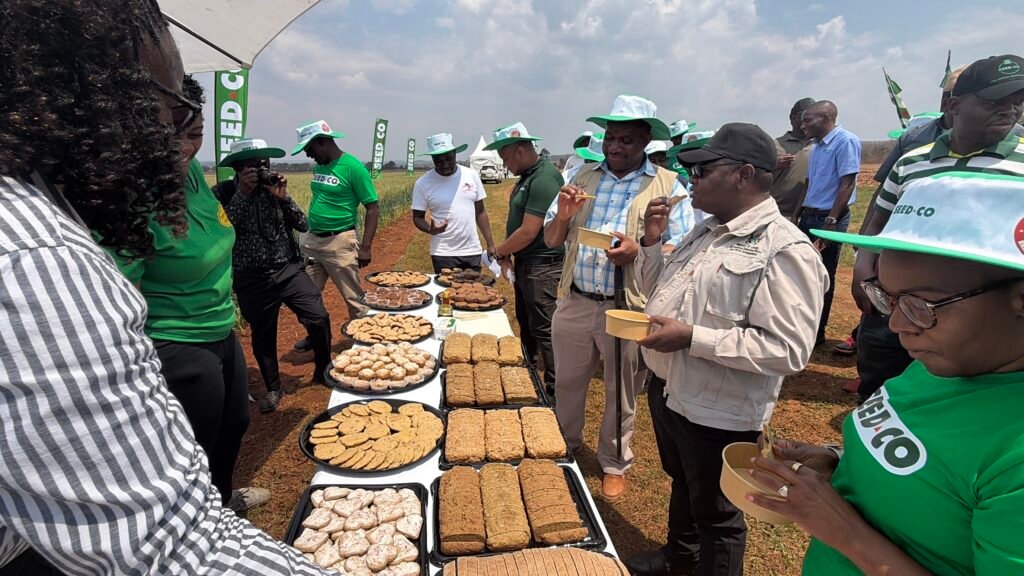
The variety’s quality credentials were put to the test at the field day, where, Cathy from Mibrand showcased a range of baked products made from SCW9104 flour.
“This is an amazing flour. It is very alluring,” the Cathy said. “And you can see the superiority of the colour, the brilliant white colour, that is very, very amazing to me.”
Beyond its appearance, the baker highlighted the flour’s versatility, pointing to products blended with carrot and coconut. “We had fun with it. It can be used for so many things,” the baker said. “We are trying to show that you can mix it with so many other things.”
Government commends seed industry investment
Guest of Honour Professor Dr Obert Jiri, Permanent Secretary in the Ministry of Agriculture, Mechanisation and Water Resources Development, said Zimbabwe’s wheat success could not be separated from the science behind the seed.
“A record harvest is visible in a field, but the years of research behind a successful variety are less visible,” he said, noting that breeders make selections year after year, researchers test across environments, agronomists evaluate performance, farmers participate in trials and seed business teams make improved genetics available.
Prof. Jiri described SCW9104 as “not simply another variety entering the market”, but a reflection of Seed Co’s continued investment in research and its response to the changing needs of Zimbabwean agriculture. Modern wheat breeding, he said, must answer several questions at once, from how much can be produced and how resilient a variety is, to what the miller, the baker and ultimately the consumer require.
He commended the company for its sustained commitment. “For 86 years, you have continued to invest in the science of African agriculture. Today we see the fruits of that investment in our farmers, our wheat fields, our national production and in SCW9104,” he said.
Looking ahead, the Permanent Secretary said the ambition must go beyond producing enough. “We must produce better, more efficiently, competitively and sustainably. That requires continuous innovation, and today Seed Co is giving us another tool to advance that journey.” He called for continued investment in the bridges between research and farmers, stronger public-private partnerships, and seed technologies that will allow Zimbabwe to feed itself, grow its economy and compete with confidence.
From research station to farmer’s field
Both speakers stressed that a variety’s value is proven not at a launch but in farmers’ fields. Ndawi-Gurajena urged farmers to engage Seed Co’s breeders and agronomists, compare plots, and discuss planting dates, nutrition, irrigation and disease management, adding that the company wants the farmer’s voice to “travel directly into the breeding programme and come back as a better product, a better recommendation or a better service.”