
By Kirsty Chibovero
HARARE – A flooded classroom, a borehole turned salty by a rising sea, a health clinic with no power when a storm cuts the grid. For millions of children in Zimbabwe and the Comoros, this is what climate change looks like. It rarely makes headlines, yet it decides whether a child eats, learns, or gets treated when sick.
This week in Harare, government officials, development partners, technical experts and young people are asking a hard question: is climate action reaching the children who need it most?
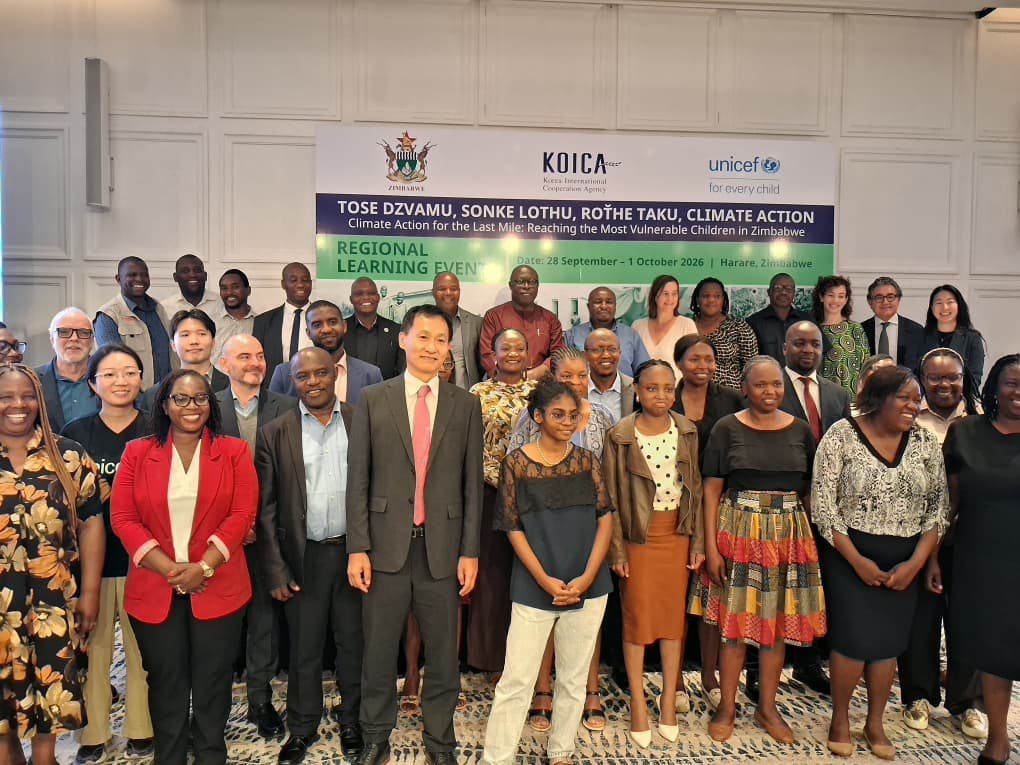
The first regional learning event for the Climate Action for the Last Mile (CALM) project runs from 28 September to 1 October 2026. The initiative is funded by the Korea International Cooperation Agency (KOICA) and implemented by UNICEF. It brings delegations from Zimbabwe and the Comoros together to take stock of progress, compare notes and decide what comes next.
Opening the event, UNICEF Zimbabwe Representative Etona Ekole said the burden of climate change falls hardest on those who did least to cause it. “For children, it is not a distant environmental issue,” she said. It reaches into their health, schooling, nutrition and safety, today and in the years ahead. Children, she added, are “also leaders, innovators, and advocates for change,” and their perspectives push adults “to act more ambitiously, and to remain accountable to future generations.”
KOICA Director General Hyunjoon Roh, joining from Seoul, set a demanding standard for success. Resilience, he said, should be judged not by how many people a project reaches, but by whether essential services keep working when a crisis hits.
An island nation on the front line
The Comoros delegation brought the view from a Small Island Developing State, where the sea is both a lifeline and a threat. Secretary General of the Ministry of Environment Abdourahamani Ali Mroivili said about 54 percent of Comorian children live in high-risk areas. In 2024, flooding affected nearly 23,000 children. Coastal erosion, rising seas and the salinisation of water supplies are adding new health risks for families already under strain.
His most striking news was a policy first. The Comoros’ NDC 3.0, the national climate plan published on 30 March 2026, now includes a chapter devoted to children’s health, protection and rights. He credited the KOICA-UNICEF project, including a national analysis of how climate change affects children, which has become a reference document for government planning.
Mr. Mroivili was blunt about what it will take to go further. Coordination between ministries, he said, “should not be viewed as a mere administrative formality.” It is the condition for any lasting result. He cautioned against copying solutions from one country to another. The goal is to find principles that can travel and then adapt them to local realities. On youth, he was equally direct: their engagement “must not remain symbolic.” Young people’s proposals need a permanent route into public policy, investment plans and local resilience frameworks.
Zimbabwe: turning results into systems
Zimbabwe’s Permanent Secretary for Environment, Climate and Wildlife, Simon Masanga, framed the week around one question: can what works be built into national systems and sustained after the project ends? He urged delegates to be honest about what worked and why, and described young people’s voices as a “reality check” on whether services truly reach the last mile.
Acting Director of Climate Change Management Kudzai Ndidzano pointed to results on the ground. More than 3,000 students now belong to school environment clubs, run by 150 trained teachers and patrons. Over 50 young people have been certified as solar installers, and about 1,900 solar lanterns are going to learners in off-grid homes. Drip-irrigated gardens are feeding school meal programmes, while 831 community workers have been trained in climate-smart child protection. Inside government, 120 focal points have learned to tag climate spending in national budgets.
He added that Zimbabwe’s Climate Change Act has cleared both houses of Parliament and now awaits presidential assent.
Beyond the usual climate sectors
HyunKyung Jasmine Lee, Programme Specialist at UNICEF’s Climate Resilience Centre of Excellence satellite office in Nairobi, placed the Harare meeting in a wider frame. CALM runs in five countries: Zimbabwe, the Comoros, Timor-Leste, Papua New Guinea and the Solomon Islands.
The project works on two tracks. The first delivers services families feel directly, from climate-resilient water systems and solar power in schools and clinics to nutrition, education and child protection. The second builds what she called the “systems backbone”: risk data, child-responsive climate policy and public finance analysis that keep those services running at scale.
One of CALM’s distinctive contributions, she said, is showing that climate change touches sectors rarely treated as climate issues, such as child protection and social protection. A drought that pushes a family into debt can end with a child pulled out of school or married early. Planning for climate risk means planning for that too.
The week’s agenda follows five aims: learning across countries, stronger collaboration between sectors, better monitoring and evaluation, strategies for scale and sustainability, and youth-led innovation. Lessons will be documented to shape a possible second phase.
Delegates now move into thematic sessions on solar-powered water systems, the Comoros’ NDC process and community listening circles. Young people from Zimbabwe, joined online by peers from the Comoros, will lead a dedicated youth session. A field visit to three project sites follows, then a session with Korean climate organisations and startups, and a discussion on waste management, an issue communities have repeatedly raised.
The Comoros delegation summed up the task ahead: to turn “learning into decisions, decisions into actions, and actions into lasting improvements in children’s lives.”